
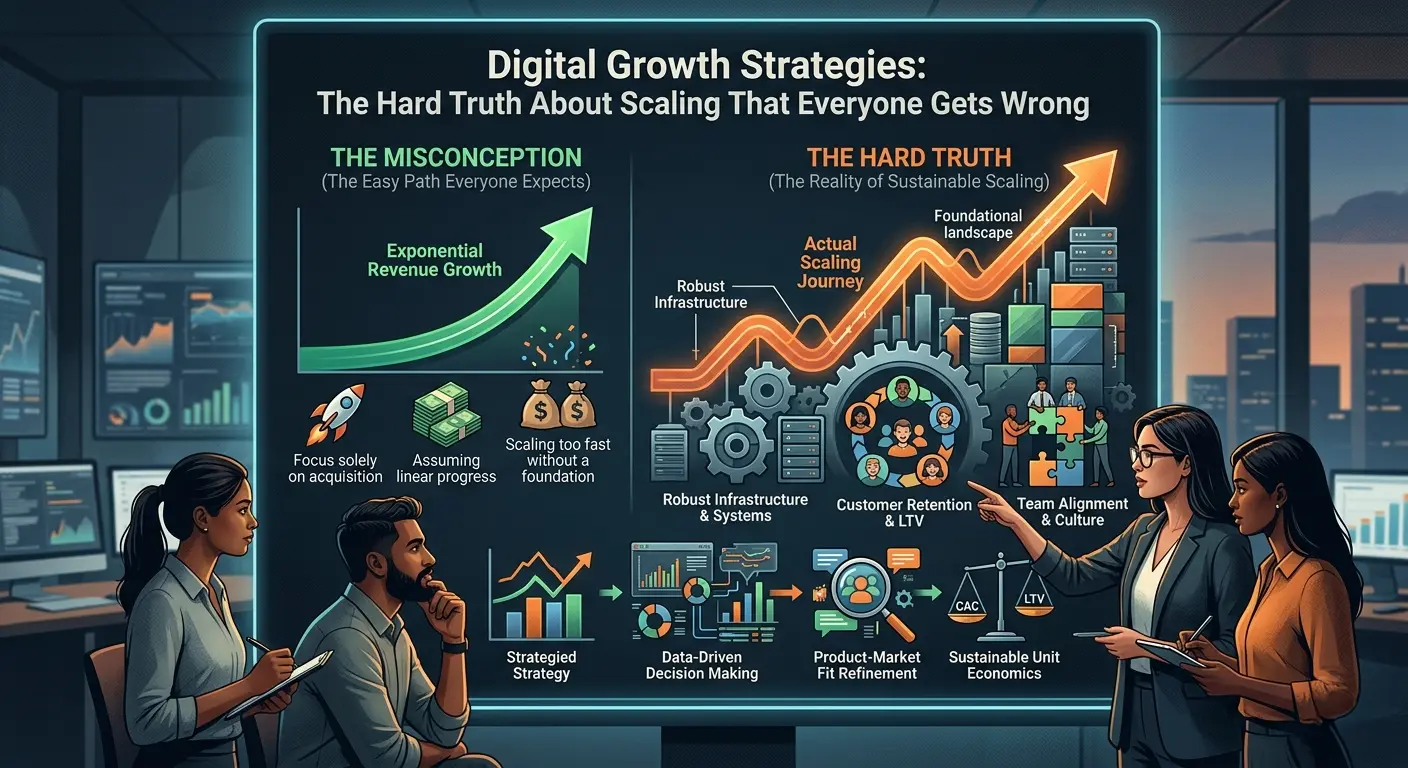
Most digital growth strategies promise transformation, but 70% of digital transformations fall short of their objectives. The reason? Scaling doesn’t just multiply your revenue; it multiplies your problems too. We’ve seen businesses triple their customer base only to watch support requests overwhelm their teams and profit margins vanish.
In this piece, we’ll walk through why traditional digital marketing growth strategies fail at scale and the biggest lies keeping you stuck. You’ll also learn how to build systems that work. You’ll learn to identify real bottlenecks and use digital platforms growth strategies the right way. We’ll also cover how to measure what matters for lasting growth.
Why Most Digital Growth Strategies Fail
The illusion of linear scaling
Businesses approach growth with a simple mental model: double the marketing spend, double the revenue. Add more people, get more output. Organizations don’t scale linearly at all though. Complex systems like businesses require different structures, capabilities and approaches to quality control as they expand.
A customer service process that handles 100 users becomes overwhelmed at 10,000. The playbook that worked for your first hundred customers breaks when you’re serving thousands. You’re not just doing more of the same thing; you’re operating a different business fundamentally. The OECD found that high-growth firms create 50-70% of new jobs in many economies, but most businesses confuse activity with actual scaling.
Growth is linear. You double your resources to double your results. More people, more hours, more stress. The hustle increases while profit margins stay flat. Scaling works exponentially in contrast. You increase results while keeping resources lean and build systems that produce 10x output without 10x effort. Most digital growth strategies fail because they pursue linear growth while calling it scaling.
Multiplying problems instead of solutions
You don’t just grow your business when you scale quickly. You increase every flaw in your foundation. Small operational weaknesses that were manageable at lower volumes explode into fatal failures at scale. What looked like solid performance was often just arbitrage of favorable early conditions.
Harvard Business Review tracked 3,000 startups and found that 70% failed within five years because they grew without building scalable systems. They chased revenue while their unit economics deteriorated in the background. Customer acquisition costs climbed. Margins thinned. The model broke under its own weight.
Failed growth strategies share one feature: they react to weakness instead of building from strength. Maybe growth stalled or a product launch backfired, and the business searches for any diversification strategy to build momentum desperately. Then resources spread even thinner while competitive advantages disappear. Organizations with formalized market monitoring processes respond to disruption 40% faster than reactive competitors, yet most businesses scale before establishing these foundations.
What worked at $100K won’t work at $1M
Reaching $100K in annual revenue proves your business model works. Scaling from $100K to $1M represents a different challenge. You’re running a lifestyle business at $100K. You’re building a scalable company at $1M. The skills that got you to the first milestone will hold you back from the second actively.
You become the bottleneck. Your capabilities built the business, but now they limit it. Systems weren’t designed for scale; what worked for you doesn’t work for a team. You face a leadership gap because you excel at doing the work, not yet at leading others to do it. The market saturates as the same customers and same tactics hit diminishing returns.
The most common mistake is trying to scale before building foundations. Entrepreneurs see early success and assume doubling down will double results. Scaling magnifies problems instead of solving them as a result. McKinsey research shows that companies investing in scalable systems are 33% more likely to achieve long-term profitability compared to firms caught in the growth trap.
Early traction often comes from conditions that disappear as you grow. Cheap reach. Forgiving customers. Manual workarounds that don’t scale. What looked like performance was actually arbitrage, and arbitrage always ends. Ask what breaks when this works too well before committing to any growth tactic. You’ve identified a liability dressed up as success if a channel requires constant optimization, manual fixes or platform loopholes to maintain performance.
The Biggest Lies About Scaling Your Business
Lie 1: More traffic equals more revenue
Traffic feels like progress. Watching visitor numbers climb creates the illusion that growth is happening. More traffic doesn’t mean more sales in reality. You could drive 1 million visitors to your website and still see zero conversions if you’re attracting the wrong audience.
The problem starts when digital marketing growth strategies focus on visitor counts instead of visitor quality. Not all traffic carries equal value. Targeted buyers convert. Random visitors bounce. Your content and offers simply fail to generate sales when you’re not addressing your ideal audience. Google Analytics reports tell the story: short visits, high bounce rates, minimal engagement with offer pages and almost no email signups.
Conversion is what builds sustainable growth, not visibility. Scaling traffic without fixing conversion leaks resembles pouring water into a leaking bucket. High website traffic can mask deeper performance problems because even a weak conversion rate generates some results when thousands of visitors arrive. But improving conversion rate from 1% to 3% could exceed the revenue effect of doubling your traffic. The difference between those percentages isn’t minor; it’s transformational.
Half of leads in any given system are not yet ready to buy. MarketingSherpa reports that almost 80% of new leads never make a purchase at all. Traffic creates a chance, but only conversion creates results. Fix conversion leaks before scaling acquisition or you’ll simply increase bounce rates.
Lie 2: You can automate your way to growth
Automation promises efficiency and delivers it in many cases. But automation isn’t the silver bullet for scaling that most digital growth strategies assume. Organizations automate broken or poorly executed processes that yield few improvements. Deploying automation in the dark without understanding what’s happening in your workflows wastes resources and perpetuates inefficiency.
You can’t automate strategy. Foundational studies remain necessary to learn about your consumers and what motivates them. AI can categorize and make sense of data, but humans still determine if it makes sense for your business or if it’s even meaningful. Insight is only as good as the decisions you make because of it.
Automation handles repetitive, rule-based tasks that require little to no human judgment. It should complement human roles, not replace them, where human presence adds irreplaceable value. The automation paradox reveals that the more you automate, the more valuable human touchpoints become in delivering meaningful experiences. Companies waste resources without lining up automation to business goals.
Technical readiness represents another barrier. Many organizations have data silos and fragmented processes that pose serious impediments to automation and require costly reengineering before automation can occur. Worker productivity improves when repetitive tasks are automated using tools like RPA, but such gains often pale next to those obtained by modernizing end-to-end employee and customer experiences.
Lie 3: Scaling is just about spending more on ads
Over 70% of small businesses spend more than half their marketing budget on paid social media campaigns. This heavy dependence on ads leaves them vulnerable to rising costs, sudden changes in platform algorithms and fleeting attention spans. Nearly 75% of performance marketers are experiencing diminishing returns on their social media ad spend.
Paid advertising delivers quick returns, but this speed can be deceptive. SEO tends to be more cost-effective over the long term, with an ROI ranging from 500% to 1,300%, while paid ads offer a 200% ROI. Industries like real estate and financial services have seen SEO ROI as high as 1,389% and 1,031%, with breakeven periods ranging from 9 to 13 months.
Brands find themselves dependent on ever-rising ad costs and an unstable flow of guides without a strong organic foundation. Costs of advertising platforms continue to rise, and competition for attention is fiercer than ever. Ads generate diminishing returns over time, meaning the same budget buys fewer clicks or weaker engagement.
Scaling isn’t about increasing results through proportional cost increases. Scaling creates more revenue without adding a proportional amount of resources. Platforms like Facebook and Instagram have evolved into ad-driven ecosystems where visibility depends on paid placements. Paid campaigns work for launches, promotions or rapid testing, but they should work hand-in-hand with organic strategies that ensure stability and long-term visibility.
Lie 4: Your competitors are your biggest obstacle
Business owners obsess over competitor moves while their real problems multiply inside the organization. Your competitors aren’t the bottleneck. You are. The biggest obstacles to scaling live inside your organization: broken processes, capacity constraints, leadership gaps and systems designed for yesterday’s volume.
Businesses fail to scale because they’re not ready for complexity, not because someone else is outperforming them. Scaling often makes things more complex, not less. Leading a team, managing more moving parts and making bigger decisions create new challenges. Scaling creates more stress instead of less if you’re not ready for that complexity.
Scaling doesn’t guarantee ease or freedom. Freedom comes from clarity, from building a business rooted in intention rather than growth for growth’s sake. Some organizations want steady, sustainable businesses that provide freedom, creativity and sufficient income rather than empires. Lining up matters more than beating competitors.
The Real Problems That Kill Digital Growth
The theoretical challenges of scaling pale compared to the operational disasters that actually kill growth. Businesses worry about competition and market position while internal breakdowns destroy their knowing how to scale. These problems don’t announce themselves until they’ve caused damage.
System overload and broken processes
CRM runs the sales teams. Spreadsheets house the projects. The warehouse has its own tracker. Nothing syncs. Chaos erupts when it’s time to work together. Sales promised something that Ops doesn’t know about. Field teams can’t see install schedules. Leadership can’t track anything in real time.
Teams drown in emails, paper forms, and cut-and-paste reporting because of manual workflows. It’s not just slow; it’s risky. One wrong entry triggers rework, compliance issues, and delays. Spreadsheets remain flexible until they’re not. They don’t scale, break easily, aren’t built to work together, and create multiple conflicting versions of the truth.
Outdated technologies power legacy systems that lack the flexibility needed to adapt to modern digital solutions. Compatibility issues, data migration complexities, and the need for extensive customization create integration woes. Disconnected and complex processes lead to higher operating costs, expenses, and errors. Technical challenges account for 17% of the barriers to successful digital transformation. Even carefully planned initiatives face setbacks when current systems are complex or disconnected.
Team capacity hits the ceiling
Capacity planning failures show up as consistently missed deadlines and stressed or defensive team members. Urgency instead of importance drives priorities. Fire-fighting happens frequently. Employee turnover runs high. Teams become stressed when workload exceeds capacity. Quality declines and turnover increases.
Leadership bottlenecks arise when key decisions rely on a single director or partner. Even highly capable leaders can only make so many decisions before quality, timing, or clarity suffers. Skills gap issues threaten to slow down digital transformation. A shortage of experts stymied progress according to 44% of respondents in one survey. Adding new talent and systems is costly, said 32%. A lack of skills to implement these systems led to delayed progress, said 29%.
Companies lose revenue when projects aren’t completed on budget or on time. People get sidelined, which reduces profitability. Team members become overworked. Senior profiles have to step in to save projects. Balancing employee workloads and assigning people with the right skills to the right tasks results in satisfied and productive employees less likely to quit due to illness or burnout.
Customer experience breaks down at scale
Customer experience quality sits at its lowest point since 2016. Only 3% of brands are customer-focused and prioritize consumer needs in all business decisions. Recent data shows that only 6% of brands improved their customer experience scores while 21% saw a decline.
Brands fail to line up business processes with consumer needs. This leads to frustrating customer experiences and declining loyalty. Customers either hop between channels or use multiple channels at the same time without satisfaction because of inadequate omnichannel experiences. High-effort digital platforms require customers to exert effort to accomplish tasks that could be optimized.
The typical agent now needs to guide through five or more systems to resolve a single interaction. This adds layers of difficulty to an already demanding role. Scripted and disempowered agents lack the authority to handle issues that deviate from standard procedures. This leads to frustrating interactions for customers who require tailored solutions.
Profit margins disappear with volume
90% of CFOs are concerned their organizations won’t hit revenue forecasts according to one report. Margin erosion occurs when the gap between costs and selling prices narrows over time and reduces profit margins. Because it develops gradually, margin erosion is often overlooked until its financial effects become severe.
Discount dependency drives volume, but each discount narrows contribution. A product sold at a 10 percent discount with a 70 percent variable cost needs roughly 50 percent more volume to maintain the same gross contribution. Accelerated shipments slip from exception to routine. A lane that costs 1.8 USD per unit may jump to 4.0 USD when rushed. The last margin points disappear once more than five percent of orders run that way.
Poor mix discipline fills capacity with what moves fastest, not what pays best. The result is a busy plant and flat EBITDA. Growth that depends on discounts, rush orders, third-party services, or reactive scheduling adds stress faster than it adds profit.
Building a Digital Marketing Growth Strategy That Actually Scales
Focus on unit economics before volume
Unit economics measure the profitability of selling one unit of your product or service. You need to know if your business model works at the individual transaction level before you scale anything. A new customer acquisition can cost five to seven times more than retaining an existing one. SaaS businesses face acquisition costs four to five times higher than retention.
The most common mistake involves omitting quasi-variable costs from calculations. Customer service representatives, returns and technology costs often get miscategorized as fixed expenses when they vary with output. The scope to achieve profitability becomes limited if you lose money before covering fixed costs.
Improved unit economics with scale is a risky strategy to bank on. This analysis shows profitability on a variable cost basis so you can foresee a credible path to breakeven. Higher ticket sizes and absolute profits help companies grow more easily into their fixed cost base.
Create systems that work without you
Your business doesn’t work if it can’t run without you. Founder-dependence is a structural weakness that stifles your team and cripples valuation because buyers don’t invest in businesses where the founder holds everything together.
Track your time for a week. Identify patterns, repetitive tasks and decisions only you seem to make. Sort them by frequency, friction and effect. Document these processes using screen recordings or step-by-step checklists. Then delegate ownership, not just tasks. Define what success looks like, set boundaries and let your team propel results.
Build an accountability chart that defines roles by responsibilities, not people. Pair it with scorecards featuring three to five key metrics per role and review them in weekly meetings. This cadence builds consistency and trust while eliminating single points of failure.
Build for retention, not just acquisition
Studies show that a 5% increase in customer retention can boost profits by 25% to 95% over time. Existing customers are 50% more likely to try new products and spend 31% more than new customers. Brands have a 60-70% chance of making a sale to an existing customer, but that number drops to 20% for new customers.
Retained customers provide predictable revenue, better feedback and brand advocacy. They refer family and friends, creating a double win for both retention and acquisition. An exclusive focus on acquisition while neglecting retention results in higher churn and wasted marketing spend.
Utilize digital platforms growth strategies
Digital platforms employ four common growth strategies. Market penetration captures share from competitors in existing markets. Market development identifies opportunities in new geographical markets, where platforms can internationalize faster due to network effects. Product development introduces complementary or substitute services and benefits from indirect network effects. Diversification enters new markets with new products, though it involves the highest risk.
How to Scale Smarter Instead of Bigger
Identify and fix bottlenecks first
Bottlenecks don’t announce themselves until they’ve stalled growth already. Start by auditing your calendar. Tasks pile up waiting for your input if you’re the single point of approval for decisions. The founder bottleneck isn’t a time problem; it’s a cognitive bandwidth problem. Research on working memory suggests we can hold three, maybe four active contexts before decision quality degrades.
Count the number of distinct strategic domains you manage. Your calendar isn’t the issue if it’s more than four. Hand off entire domains instead of delegating individual tasks. Not “handle this client call” but “you own client delivery, and I trust your judgment on how to run it”. Map your workflows to spot where delays appear, then track time for each step. Break down why if one phase takes double the expected duration.
Implement flexible technology infrastructure
Flexible infrastructure grows capacity without requiring complete system overhauls. Adopt unified systems that integrate compute, storage and networking in one appliance. Modular units make granular scaling possible where each node adds capacity without disrupting existing operations. Standardize hardware and software to reduce training requirements and accelerate deployments while lowering support volume.
Automation eliminates repetitive manual steps through Infrastructure as Code and zero-touch provisioning. Track CPU, memory and storage utilization using analytics dashboards. Set thresholds to auto-scale and conduct capacity reviews quarterly.
Develop repeatable processes and workflows
A repeatable process needs three elements: a clear trigger, defined steps and a measurable endpoint. Before scaling, identify your key processes by asking what activities affect customer experience, which tasks repeat often and where errors appear. Standardization doesn’t mean bureaucracy; it reduces errors, makes training simpler and enables automation.
Document workflows so different team members produce consistent results. Test documentation with someone unfamiliar with the task, then refine based on their feedback.
Train your team for growth phases
So, invest in leadership training for yourself and your team. Enabling others to lead becomes necessary for sustainable success as your business grows. Focus on specialized training programs that arrange with your specific needs. Leadership development and operations management with delegation strategies free up time to do strategic work.
Measuring What Actually Matters When Scaling
Track leading indicators, not just revenue
Revenue tells you what already happened. Leading indicators predict what’s coming next. Monthly recurring revenue is a lagging indicator. You see last month’s MRR too late to change it. Measure app engagement (a leading indicator) and notice strong metrics. You can expect to retain users and maintain high MRR.
Leading indicators let you act before problems compound. Engagement drops in week two of the month. You can break down and solve problems before churn hits and MRR takes damage. Session duration, activation rate, and your north star metric all function as leading indicators for SaaS companies.
Monitor customer acquisition cost trends
Customer acquisition cost isn’t static. You need to track CAC to spot trends and see how strategy changes affect acquisition costs regularly. Malcolm Allen notes that monitoring CAC will give a cost check on acquiring each new customer. This helps you make informed decisions about marketing strategies and customer retention efforts.
Measure team efficiency and burnout signals
Productivity per employee represents a critical metric when scaling fast. Tracking average working hours matters because working more than 40 hours weekly associates with higher burnout levels substantially. After-hours work frequency, response latency during work hours, and absenteeism all serve as burnout indicators.
Use data to predict scaling challenges
Leading metrics act as early signals that let you steer before trouble arrives. Spot signals in lagging indicators like churn spikes and uncover root causes through leading indicators such as poor onboarding. Take proactive action before problems escalate.
Conclusion
Scaling your business requires fixing what’s broken before adding more volume. Focus on unit economics first, build systems that work without you, and prioritize retention over acquisition. We’ve seen many businesses chase traffic and ad spend while their profit margins disappeared and their teams burned out.
Start by identifying your biggest bottleneck today. Fix that single constraint before investing another dollar in growth. Track leading indicators instead of vanity metrics, and you’ll spot problems weeks before they damage your revenue. Scaling smart beats scaling big every time


